Guides
Implant vs. Bridge vs. Denture
If you are replacing one or more missing teeth, the three common options are a dental implant, a bridge, or a denture. Each works in a different way, and the right plan depends on your mouth, your goals, your budget, and what a board-certified oral and maxillofacial surgeon or restoring dentist finds during an exam.
What each option involves
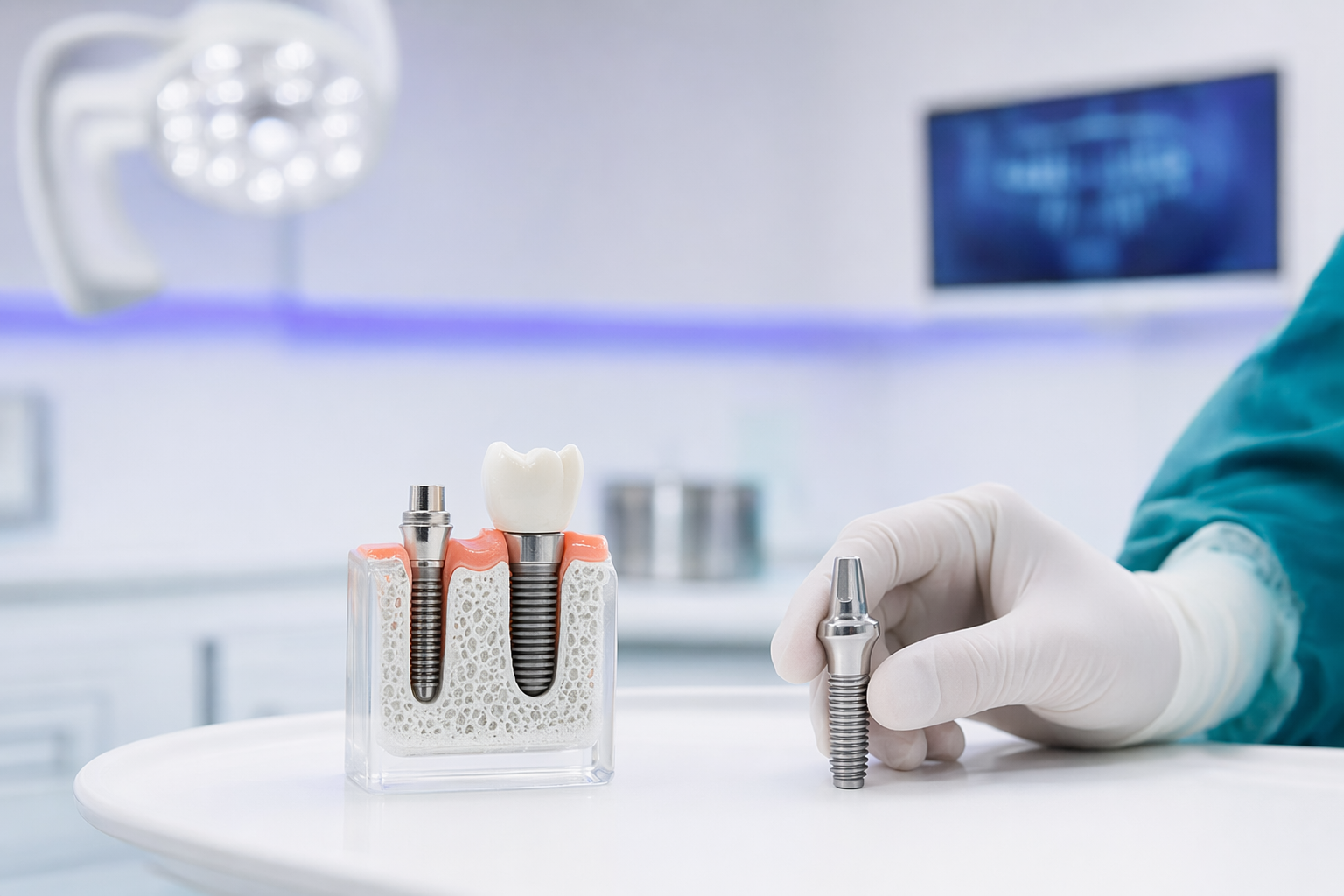
A dental implant is a small post placed in the jawbone where a tooth root used to be. In many cases, the process has several steps: consultation and imaging, implant placement, healing time while the bone bonds to the implant, and then attachment of a crown, bridge, or denture by the restoring dentist. Some cases also involve bone grafting before or during implant placement.
A bridge usually replaces one missing tooth by connecting an artificial tooth to the teeth next to the gap. In a traditional bridge, the nearby teeth are shaped to hold crowns, and the replacement tooth is attached between them. In some situations, an implant-supported bridge may be discussed instead of a bridge that relies only on natural teeth.
A denture is a removable replacement for several teeth or a full arch of teeth. A partial denture fills some gaps. A full denture replaces all teeth in the upper or lower jaw. Some dentures rest on the gums. Others can attach to implants for added stability.
These options are not interchangeable in every case. Bone levels, gum health, nearby teeth, bite forces, and general health can all affect what an oral surgeon or dentist may recommend. You can learn more about common procedures at /procedures/.
- Implant: placed in bone, then restored with a crown or other tooth replacement
- Bridge: attached to nearby teeth or supported by implants
- Denture: removable, full or partial, sometimes supported by implants

How they compare on feel, function, and maintenance
Many people ask which option feels most like a natural tooth. In general, implants are designed to stand in for the root and the visible tooth, so they often feel more secure than removable options once treatment is complete. A bridge stays fixed in place, but it depends on support from other teeth or implants. A traditional denture is removable, so it may move more during chewing or speaking, especially as the mouth changes over time.
Cleaning is also different. An implant crown is cleaned much like a natural tooth, though special tools may be suggested in some cases. A bridge often needs extra cleaning under the artificial tooth. A removable denture must be taken out and cleaned regularly. An implant-retained denture may still need daily removal for cleaning, depending on the design.
Appearance can be good with all three when they are planned well. Longevity also varies. In general, implants can last many years, but that depends on bone support, bite forces, home care, smoking, and follow-up care. Bridges and dentures can also last for years, though they may need adjustment, relining, repair, or replacement over time.
No option is "best" for everyone. What matters is how the plan fits your anatomy, your priorities, and the long-term maintenance you are comfortable with.
- Implants are fixed in bone
- Bridges are fixed but rely on other support
- Dentures are removable unless attached to implants
Surgery, healing, and typical recovery
The biggest difference for many people is surgery. A traditional bridge or removable denture may not require oral surgery, although tooth removal or other preparatory work can sometimes be part of the plan. An implant does involve a surgical procedure to place the implant into the jaw. If bone grafting is needed, that can add another step and more healing time.
Typical recovery after implant placement is often measured in two phases. The first is the short-term recovery from the procedure itself, which may include soreness, swelling, and changes to eating for several days. The second is the deeper healing period while the bone bonds to the implant, which commonly takes a few months. Typical timelines are not a promise. Everyone heals differently.
With bridges and dentures, the recovery is often more about getting used to the new appliance. Some people notice pressure, sore spots, speech changes, or chewing adjustments at first. Follow-up visits are common so the provider can adjust the fit.
After any oral surgery, the surgeon will give specific instructions. In general, heavy bleeding that does not slow, trouble breathing or swallowing, or a serious facial injury should be treated as an emergency, and the person should call their local emergency number first. For non-emergency concerns after a procedure, it is reasonable to contact the treating surgeon's office. You can read more general education on recovery and sedation topics in /guides/.
- Implants usually involve surgery and a healing period
- Bridges and dentures may involve adaptation and adjustments
- Recovery times are typical only, not guaranteed
Cost in the U.S.: honest ranges, not quotes
Cost is often a major factor. Real prices vary by the number of teeth involved, the materials used, whether extractions or bone grafting are needed, the type of sedation, your insurance, and where you live. These are ranges, not quotes.
For a single dental implant, a common total range in the U.S. for the implant, abutment, and crown is often about $3,000 to $6,500+ per tooth. If bone grafting, sinus lift procedures, or more complex imaging and sedation are needed, the total can be higher.
A traditional bridge for one missing tooth often ranges from about $2,000 to $5,000+, depending on materials and the number of units involved. A partial denture may range roughly from $800 to $3,000+, while a full denture may range from about $1,000 to $4,000+ per arch. Implant-supported dentures and full-arch implant cases can be much higher, often many thousands of dollars more because surgery, implants, attachments, and prosthetic work are included.
When you compare options, ask for the full written plan. That should include what is and is not included, who is doing each part, the estimated timeline, and the expected fees for surgery, sedation, imaging, temporary teeth, and final restoration. A lower starting price does not always mean a lower total cost.
- Single implant with crown: often about $3,000 to $6,500+
- Traditional bridge: often about $2,000 to $5,000+
- Partial or full dentures: often hundreds to a few thousand dollars, more for implant-supported options
How to choose a surgeon and compare your options
A consultation is where the decision becomes more concrete. In many cases, the surgeon or dentist will review images, examine the area, and explain what options may be possible. If surgery is part of the plan, ask whether the surgeon is board-certified in oral and maxillofacial surgery, and verify credentials yourself. It is also reasonable to ask who will place the implant, who will make the final tooth or denture, and what follow-up care is included.
A second opinion is always reasonable, especially if the plan is complex or the costs are very different between offices. You are the decision-maker. Compare experience, communication, sedation options, expected timeline, and how clearly each office explains risks, alternatives, and total cost before scheduling.
Helpful questions to ask include: 1. What are my options and how do they differ? 2. Will I need bone grafting or extractions? 3. What sedation options are offered, and what are the main risks in general? 4. What is the total expected cost in writing? 5. What maintenance or future replacement might be needed? 6. What does the typical recovery look like in this practice?
If you want help finding offices to contact, /get-matched/ is free to the patient. You share only contact details and basic interest information, not medical records or financial account numbers. Language help is often available, which can make it easier to ask questions and understand the plan.
- Choose a board-certified oral and maxillofacial surgeon when surgery is involved
- Get the treatment plan and full cost in writing
- A second opinion is reasonable
Implants, bridges, and dentures all replace missing teeth, but they differ in surgery, cost, feel, and long-term maintenance, so it is smart to compare written plans with a board-certified oral surgeon or dentist before deciding.
Common questions
Is an implant better than a bridge?
Not for everyone. An implant, bridge, or denture may each make sense in different situations. The best choice depends on bone, nearby teeth, bite, budget, and what the treating professionals find on exam.
Do dentures always require surgery?
No. Traditional removable dentures may not require surgery, though extractions or other preparatory treatment can sometimes be part of the process. Implant-supported dentures do involve surgery to place implants.
How long does implant treatment take?
It varies. The short-term recovery after placement may be days to a couple of weeks, while deeper healing between the bone and implant often takes a few months. Some cases take longer, especially if grafting is needed.
Which option usually costs the least up front?
In many cases, removable dentures have the lowest upfront cost, then bridges, then implants. But the real comparison should include maintenance, repairs, and future replacement, not just the starting price.
Should I get a second opinion before implant surgery?
A second opinion is always reasonable, especially for complex cases or large cost differences. It can help you compare options, timelines, and written fee estimates.