Quick answers
What is an impacted wisdom tooth?
An impacted wisdom tooth is a third molar that does not fully come in the usual way. It may stay trapped partly or fully under the gums or bone, or grow at an angle because there is not enough room in the jaw.
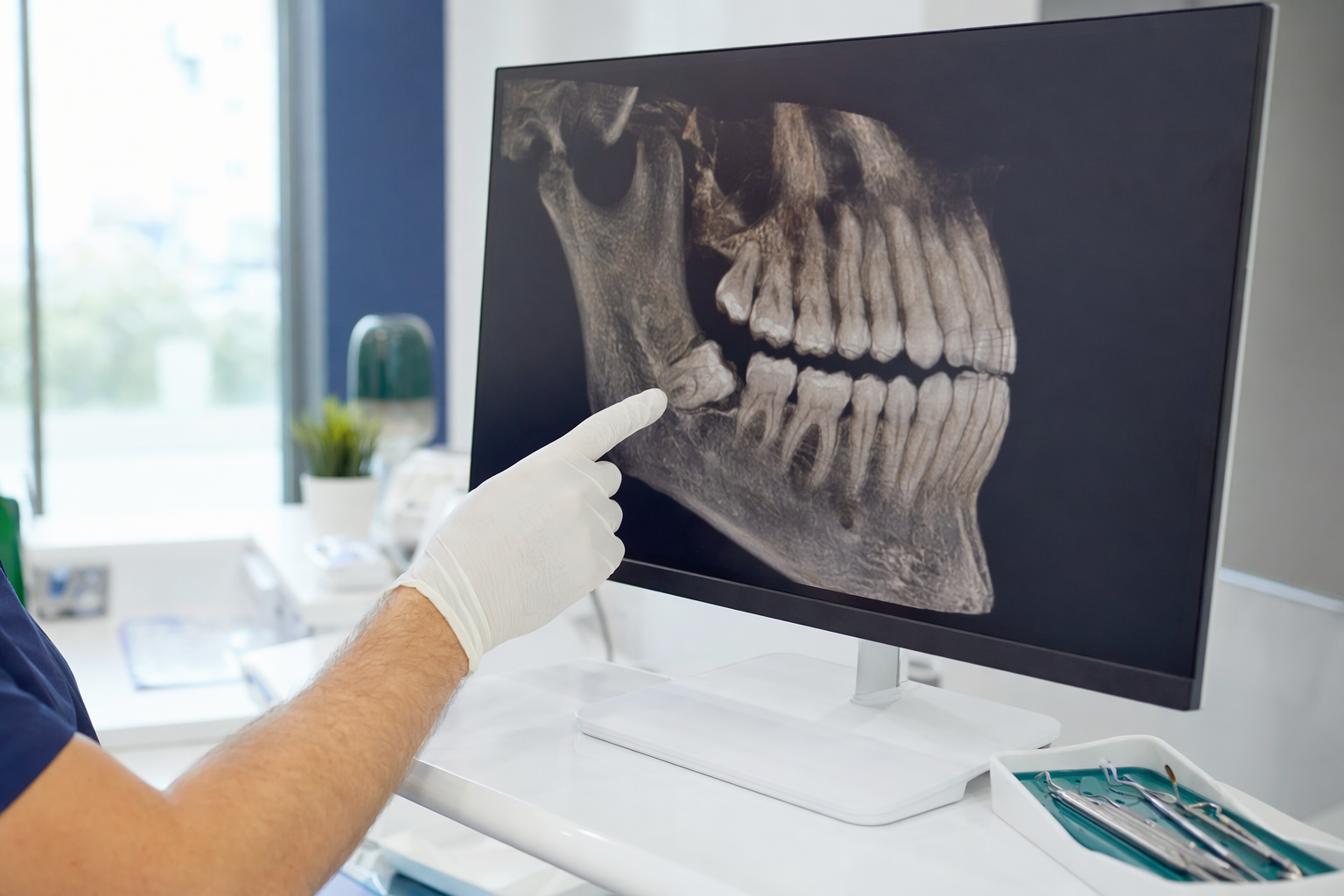
What “impacted” means
Wisdom teeth are the last adult teeth to develop. They usually appear in the late teen years or early adulthood. Some come in normally. Others do not have enough space, or they are blocked by nearby teeth, bone, or gum tissue.
When that happens, a surgeon or dentist may call the tooth impacted. In plain language, that means the tooth is stuck, only partly through the gums, or growing in a position that makes normal eruption difficult.
An impacted wisdom tooth can be fully hidden below the gums, partly visible, or tilted sideways. A dental exam and imaging such as an X-ray are often used to show where the tooth sits and how close it is to nearby teeth, nerves, and the sinus area in the upper jaw.
- Impacted = stuck, blocked, or unable to come in normally
- It may be fully under the gums, partly out, or angled
- Position matters because it can affect the surgical plan

How oral surgeons describe impacted wisdom teeth
There are a few common ways impacted wisdom teeth are described. One is by how much of the tooth is covered. A soft-tissue impaction means part of the tooth is under the gum. A bony impaction means the tooth is partly or fully covered by jawbone.
Another way is by direction. The tooth may lean forward toward the second molar, lean backward, stand upright but remain trapped, or lie more sideways than vertical. These details help a board-certified oral and maxillofacial surgeon explain the level of difficulty, the likely surgical steps, and the expected recovery.
This is also why two people can both be told they have impacted wisdom teeth but hear very different treatment plans and cost ranges. The exact position of the tooth, the roots, and the surrounding bone can change the time, tools, sedation options, and overall complexity.
- Soft-tissue impaction: partly covered by gum
- Bony impaction: partly or fully covered by bone
- Tooth angle and root shape can affect the plan
What symptoms or problems can happen
Some impacted wisdom teeth cause no obvious symptoms for a while. Others may be linked with swelling, jaw soreness, pressure, bad taste, food trapping, or trouble cleaning the area well. In some cases, the gum around a partly erupted tooth can become irritated.
An oral surgeon may also look for signs that the tooth is affecting the neighboring molar, surrounding bone, or gum health. That does not always mean surgery is needed, and this page cannot tell you what is right for your situation. It means a licensed surgeon can review the images, explain what they see, and talk through the choices.
If you were told you might need wisdom tooth surgery, a consultation is the next step. A second opinion is also reasonable. You can start with general education in our help center or use the free matching service if you want to compare board-certified surgeons in your area.
- Some people feel symptoms, some do not
- A consultation helps show what is happening under the gums
- A second opinion is always reasonable
What removal usually involves, in plain steps
If a surgeon recommends removal, the process usually starts with an exam, imaging, and a discussion of sedation options, risks, and expected recovery. You can ask whether the surgeon is board-certified in oral and maxillofacial surgery and verify credentials yourself before scheduling.
On the day of surgery, the team may numb the area and, depending on the plan, use a type of sedation. The surgeon may need to open the gum, remove a small amount of bone, and sometimes divide the tooth into sections so it can be taken out more safely. The area is then cleaned, and stitches may be placed.
Before you agree to anything, ask for the plan and the full cost in writing. Confirm what is included, such as imaging, anesthesia or sedation, facility charges if any, follow-up visits, and medicines. You can compare surgeons, ask questions in plain language, and take time to decide.
Many offices can help in languages other than English. If that would make the visit easier, ask whether interpreter support or multilingual staff is available. Oral Surgery Path can help you request that through the free matching service.
- Ask about board certification and verify it yourself
- Ask what type of sedation is offered and why
- Get the treatment plan and full price in writing
Typical US cost and recovery ranges
For impacted wisdom teeth, the price can vary a lot. In the US, a simple estimate for one impacted wisdom tooth may range from about $300 to $1,200+ for the surgical extraction itself, depending on depth and difficulty. Sedation, imaging, and location can increase the total. If several wisdom teeth are removed in one visit, the overall cost may range from roughly $1,000 to $4,000+. These are ranges, not quotes.
The real number depends on the case, the tooth position, the surgeon's fees, sedation type, whether you need 1 tooth or several removed, your insurance, and where you live. You can read more general price information on our costs page. Before scheduling, ask for a written estimate and what might lead to extra charges.
Recovery is often measured in days, not minutes. Many people expect swelling and soreness to be most noticeable in the first few days, then improve over about 1 to 2 weeks. Some people feel ready for routine activities sooner, while others take longer. If bone removal or a deeper impaction is involved, healing may feel slower. Typical timelines are not a promise. Everyone heals differently.
The surgeon's office should explain what is considered normal after surgery, what warning signs to watch for, and when to call them. If there is heavy bleeding, trouble breathing or swallowing, or a serious facial injury, call your local emergency number first.
- One impacted tooth may be about $300 to $1,200+
- Several teeth in one visit may total about $1,000 to $4,000+
- Recovery often improves over 1 to 2 weeks, but varies by person
An impacted wisdom tooth is a wisdom tooth that is stuck or cannot come in normally, and a board-certified oral surgeon can explain your options, recovery, and written cost estimate.
Common questions
Is an impacted wisdom tooth the same as a cavity?
No. “Impacted” describes the tooth's position and eruption. A cavity is decay in the tooth.
Can an impacted wisdom tooth stay under the gums?
Yes. Some remain fully or partly below the gums or bone. Imaging is often needed to see the position clearly.
Does an impacted wisdom tooth always need to be removed?
Not always. That decision depends on the individual case and should be made with a licensed board-certified oral and maxillofacial surgeon.
How do I choose a surgeon?
Look for a board-certified oral and maxillofacial surgeon, verify credentials yourself, ask about sedation options and risks, and get the treatment plan and full cost in writing before scheduling.
Is Oral Surgery Path a dental office?
No. Oral Surgery Path is a free education and matching service. It is not a dental or medical practice, and matching is free to the patient.